Data centers operate under unusually strict electrical requirements. Thousands of servers, UPS systems, PDUs, cooling equipment, and other electronic loads can share the same electrical infrastructure, making small power quality problems more consequential at scale. A power quality audit provides facility owners and engineering teams with measurable evidence about voltage behavior, current distortion, harmonics, power factor, and other electrical conditions before these issues become costly operational problems.
What Does a Data Center Power Quality Audit Measure?
A power quality audit begins with measurements taken at strategically selected points, such as the utility connection, main switchgear, UPS input, distribution panels, and PDUs. The objective is not simply to collect electrical data but to understand how the facility behaves under different loading conditions.
Voltage is one of the primary parameters. Engineers can monitor voltage magnitude, sags, swells, interruptions, transients, and phase imbalance. These events may help explain unexpected UPS alarms, equipment trips, or abnormal behavior in sensitive IT equipment.
Current measurements are equally important. They reveal load levels, phase balance, neutral current, and waveform distortion. Frequency, real power, reactive power, apparent power, and power factor can also be evaluated to build a more complete picture of the electrical system.
For larger facilities, measurements should represent different operating conditions rather than relying on a short snapshot. Data from normal operation, high server utilization, maintenance periods, and changing cooling loads can reveal problems that would otherwise remain hidden.
What Causes Harmonic Distortion in Data Centers?
Understanding what causes harmonic distortion is particularly important because modern data centers contain large numbers of nonlinear electronic loads. Server power supplies use power-electronic conversion stages, while UPS rectifiers and other electronic equipment can also contribute harmonic currents.
The resulting current waveform differs from an ideal sinusoidal waveform. Individual harmonic components can be measured by order, while total harmonic distortion (THD) provides a broader indication of waveform distortion.
The cumulative effect can become significant as the number of electronic loads increases. Enjoypowers specifically identifies server PSUs as a source of harmonic currents and notes the relevance of 3rd, 5th, and 7th harmonics in large data-hall environments. Its data-center solution describes active filtering at the PDU or main bus as an approach for addressing cumulative distortion.
IEEE 519-2022 provides harmonic-control objectives for systems containing linear and nonlinear loads. Importantly for facility engineers, its steady-state voltage and current distortion limits apply at the point of common coupling (PCC), rather than automatically serving as limits for every internal circuit.
Other Causes of Poor Power Quality
Harmonics are only part of the causes of poor power quality. Data centers can also experience voltage disturbances, reactive-power issues, phase unbalance, and transient events. The source may be inside the facility or associated with upstream electrical conditions.
UPS systems provide an important layer of protection, but they do not make every power quality issue irrelevant. Enjoypowers notes that double-conversion UPS systems isolate IT loads from many voltage events while some transients can still pass through and repeated disturbances can place stress on UPS rectifiers.
Power factor should also be considered. A large facility operating with substantial reactive power may require more apparent power from its electrical infrastructure. For data-center operators managing increasingly dense loads, understanding the relationship between power factor, capacity, and utility requirements can therefore form part of the audit process.
Why Harmonics Matter Beyond the Electrical Waveform
A harmonic measurement becomes more useful when it is connected to a physical consequence. Harmonic currents can contribute to additional heating in transformers, conductors, and other electrical equipment. In a data center, additional heat is especially relevant because electrical losses ultimately add to the facility’s cooling burden.
This makes power quality an operational issue rather than simply an electrical engineering metric. An audit can help engineering teams determine whether distortion is concentrated around a particular PDU, rack row, UPS system, or main distribution point.
The location of the problem also affects the appropriate mitigation strategy. A localized issue may be addressed closer to the affected distribution area, while a facility-wide problem may require centralized treatment.
How Active Filtering Fits Into Data Center Design
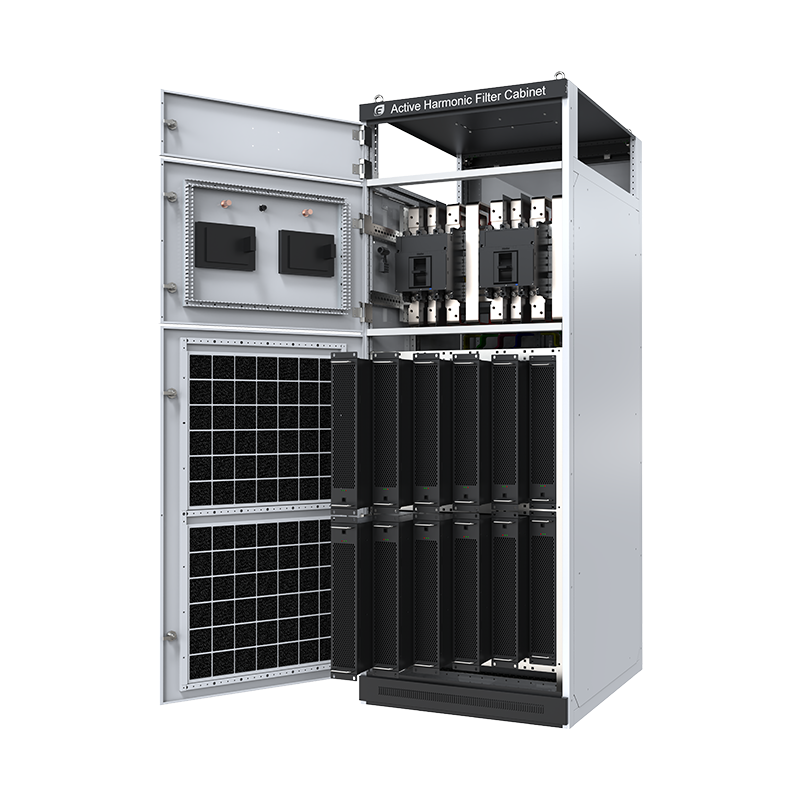
Active harmonic filters can monitor load current and generate compensating current to counteract unwanted harmonic components. Enjoypowers describes its active harmonic filter as operating in parallel with nonlinear loads, using current transformers and digital processing to identify harmonic components before generating compensation current with opposite phase.
Its SinE Series Active Harmonic Filter specification lists harmonic-current compensation from the 2nd through 50th harmonic order and an overall response time of no more than 10 ms. The published specification also lists harmonic, reactive-power, and unbalance compensation capabilities, with 200/400 V models available in rated-current configurations from 30 A to 200 A.
Enjoypowers’ dedicated data-center power quality solution describes a 5 ms response target and THDi below 5% as an attainable target. It also supports N+1 redundancy configurations, which can be relevant for facilities where power quality equipment must align with high-availability architecture.
Turning Audit Results Into a Practical Power Quality Plan
A useful audit should finish with actionable engineering conclusions. Facility teams can identify the dominant harmonic sources, determine where distortion is measured, correlate disturbances with operating conditions, and establish whether mitigation is required at the PDU, UPS input, main bus, or another electrical point.
This approach also helps avoid oversizing equipment. Instead of selecting an active filter based solely on the facility’s total electrical capacity, engineers can evaluate actual harmonic current, reactive-power demand, operating patterns, and future expansion requirements.
For data centers, understanding what causes harmonic distortion and the broader causes of poor power quality provides a stronger foundation for infrastructure planning. Enjoypowers’ data-center offering combines active harmonic filtering and reactive power compensation, illustrating how measured electrical conditions can be translated into a targeted power quality architecture rather than treated as an isolated maintenance concern.